Aggregation: Value and Price

Categories: Economics

Adam Smith’s gardener

I planted no tomatoes this year. The smaller birds have come for the cherries on the trees and the grapes on the pergola, consumed them, and mostly departed, to the cats’ disappointment. While any verdant flourishing I’ve recently tended has been metaphorical, Rascal did manage to get in some socializing with a larger friend.

two photographs: a cat on the back of an armchair at a glass door, face to face with a hawk perched on the railing outside

In the chapter of The Wealth of Nations on the components of price, Smith describes a man who cultivates his garden with his own hands and so “unites in his own person the three different characters, of landlord, farmer, and labourer” (Smith 1776, I.vi.23). The gardener’s produce ought to pay him the rent of the landlord, the profit of the farmer, and the wages of the laborer, one would think, but it pays him one sum. Smith says the whole return passes for the earnings of his labor, rent and profit folded into the wage, because nobody stands across the table from the gardener to claim them. Folks who write for sites they own, host, and maintain may recognize the arrangement.
Continue reading Aggregation: Value and Price

Commensuration: Text and Labor

Categories: Economics

{{ content }}

My fellow UMass alum Lisa Dush opens her 2015 essay on content with a WordPress writer who has come to understand good writing as posts optimized for reach through categories, tags, and search metadata (Dush 2015, 173). I resembled Dush’s writer for two decades. This place ran on WordPress until this summer, when I converted the posts to static pages, dropping the tags and consolidating the categories. Dush’s definition of content encompasses the professions that now work with writing, and she notes Tim Kreider’s complaint that the term assigned him and his artist friends the role of “content providers” on the assumption that delivery matters and the writing is “filler, stuff to stick between banner ads” (Kreider, quoted in Dush 2015, 174).

Content, in Dush’s definition, has four characteristics: it is conditional, computable, networked, and commodified. She hedges the last, noting content “is—or will be—commodified” (178). I think she’s correct in her future-tense hedge. Commodification is an event at a position rather than a property of a text: a text becomes a commodity when someone holding the position to sell it does so, and until then it stays in Dush’s future tense. She traces an example through John Trimbur’s distinction between use value and exchange value: in networked space a video or a tweet is judged on the number of clicks and retweets it accumulates, its exchange value rendered as brand reach or ad revenue (178). The endgame Dush fears for writers follows, that writing “becomes something one does for free” (191). Counting the stream of clicks sets a tweet, an essay, and an advertisement as equals; the writer of each unpaid. The machine audiences Dush names rank and match (176). A ranking is a count, and whoever holds the ranking does the valuing, since no machine can take up a use.

A ledger reaches only what it can commensurate. Thamus judged an art he couldn’t practice. Content is writing made commensurable. A ledger that counts content has already set unlike labor equal, at a ratio a person chose: “This is worth as much as that; this will be worth as much as that.”

Continue reading Commensuration: Text and Labor

Appropriation: Position and Relation

Categories: Economics

Under the cloak

I first heard the familiar joke about Plato’s Phaedrus from a classicist. Socrates encounters Phaedrus headed for a stroll beyond the city wall (Plato 1914, 227a). Phaedrus has spent the midsummer morning listening to Lysias read a speech about love (228b). Socrates flirts with “the fair young Phaedrus” (261a) as they walk the banks of the Ilissus. Lysias argued that a young man should grant his favors to a man who doesn’t love him, and Socrates, sensing that Phaedrus carries a copy of the speech (228d), demands to hear it: “Is that a scroll under your cloak, Phaedrus, or are you just happy to see me?”

The day’s heat shapes the unfolding of the flirtatious exchange. Among the reasons Phaedrus offers secondhand from Lysias for favoring the non-lover is a metaphorical ledger: favors should go to those best able to repay them (233e); the scroll, as a commodity, argues for exchange. Lysias writes speeches by trade (257c), what we might today call advocacy or ghostwriting or plagiarism, depending on context: he composes for clients in the courtroom who deliver his sentences as their own. The client takes the authorship with the text.

Continue reading Appropriation: Position and Relation

Valuation: Labor and Measure

Categories: Economics

Called to account

Decades ago in Massachusetts, my land line rang and I picked up to a recorded message. I had a call from an inmate at a Maryland correctional institution. To take the call, I’d need to set up an account with the company on the phone. The company, T-Netix, wanted my Social Security number: speaking with a Maryland prisoner required my credit rating. I wrote it up that night as an aside, venting.

The entry drew 175 comments over seven years, more than any other here. They came from people I’d never heard of in places I’d never been, all encountering the same wall: prepaid accounts, unstated rates, unsent statements. They compared notes and organized, a little, in the comments. None of the commenters was a reader I’d imagined, and I watched as an audience took my text beyond its momentary purpose. I’d posed a question six months earlier, in another entry: “do weblogs do things other than the uses their writers set them to?”

One of the commenters, in 2006, detailed the responses received and posed a question, citing the prepayment, three requests for a statement, a printout once from an operator’s screen: “don’t we as the consumer have a legal right to receive an accounting of how our money is spent?” She wanted an account. T-Netix offered a count: a balance with nothing behind it.

Continue reading Valuation: Labor and Measure

Access Clauses, Elaborated

Categories: Economics

Landscaping

Charlie Moran once remarked to our graduate seminar, regarding a reading he’d assigned, that James Berlin had caught criticism for the way he landscaped composition’s field, planting scholars like potted trees. I’ve put together an instrument that performs the juxtapositions I enjoy: a set of matrices as a translation and reduction, wherein I’ll seek to gain by comparison what I lose in nuance. I’m feeling the need to do some planting of my own, so I’m granting myself license to perform an act of landscaping similar to Berlin’s, in the hopes I might usefully clarify the concepts of an access regime and an access clause.

Ich bin ein Berliner.

Regime and clause

An access regime, as I first defined it, is what a theory lets itself assume it can know about an agent, from what evidence, and at what moment. Friedrich Hayek adds a question my post didn’t ask: by whom. A theory can be loud about what its subject is and silent about what the theory permits itself to know. The access clause is the permission made explicit: a provision fixing what the theory may treat as knowable about an interior, and on whose authority (Part 3). Every theory carries one, declared or not. The razor is the clause used as a tool: it cuts away what a theory claims to know about a mind and keeps what the theory can show from the record.

The tables below put those questions in columns. What may be known about the agent, from what evidence, at what moment, by whom: those are the regime’s terms. The last column is the sort: it says what each regime claims to reach.

Continue reading Access Clauses, Elaborated

Politics and the Paper Load: Two Resources

Categories: Composition

I recently developed two resources for our graduate teaching associates, and thought they might be worth sharing. Each is a collection of PDF articles with an introductory cover sheet; I’ve provided here the cover sheets with prefatory material and brief summaries. Teachers of college writing will recognize the contradiction in the first cover sheet: if these readings should help teachers save time, when will teachers find the necessary time to read them?

Responding to Student Writing: The Labor Question (PDF)

Politics in the Writing Classroom (PDF)

I regret the second cover sheet offers no solution to the challenge posed by the first: the debate over instructor time is political. That challenge is one aspect of the labor economics I’ve wrestled with here in various ways since 2003.

How to Do Words with Data

Categories: Composition, Information, Rhetoric

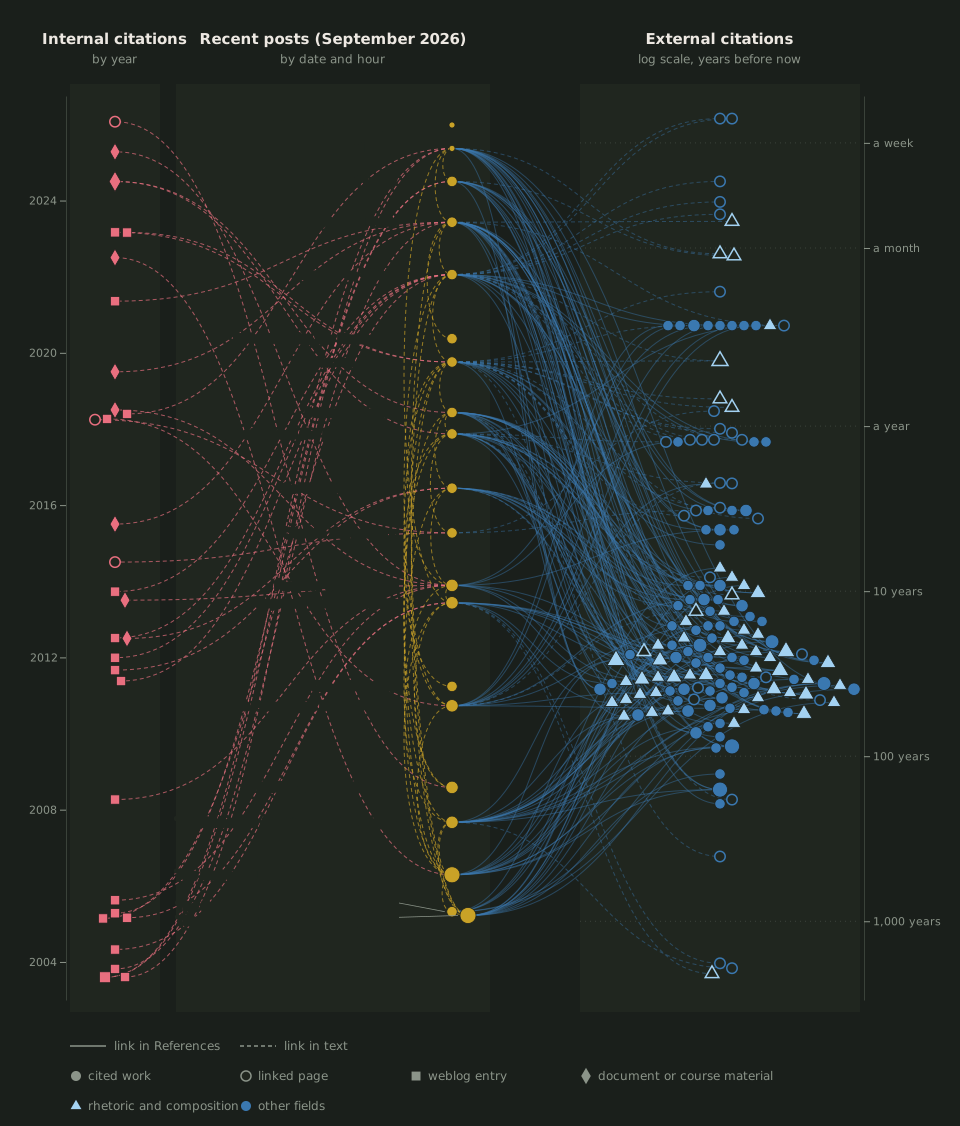
I’ve used Anthropic’s Claude to help me put together a visualization of my recent linking and citing practices. In the accompanying diagram, each column keeps its own time scale. The diagram offers no comment on the arguments themselves: those are in the center column, to be read beyond the diagram. Pop out the full figure for individual post citations.

What the September posts link to, by ageThree timelines: the weblog archive by year, the September 2026 posts by date, and works by others on a log scale of years before now, split between rhetoric and composition and other fields, with a line for each link from a September post.200420082012201620202024Sep 15Sep 22Sep 291 wk1 mo1 yr10 yr100 yr1,000 yrInternalcitationsby yearRecent posts(September 2026)by dayExternalcitationslog scale, years before nowlink in Referenceslink in textcited worklinked pageweblog entrydocument or course materialrhetoric and compositionother fields
Open the full figure

A note on method: the interactive diagram took me about forty minutes to create with Claude. I already had the clean data in my research vault; Claude wrote the JavaScript and CSS and scripted the extraction from my BibTeX sources database through the blog posts to the Mermaid-generated SVG. The minimal human labor cost of adaptation came from prior choices I’ve made in tooling and organizing and indexing the vault. I’d suggest that with properly tended data, one might easily adapt the theories of delivery proposed by Ridolfo and DeVoss to broader inquiries concerning technologies of rhetorical practice and economic self-appropriation.

And de Copia is wrong; looks like it took the bibliography’s publication date for the 1963 Marquette UP edition. Not sure why the script pulled the right field for Dio and not Erasmus. sigh. Leaving it for now.

What Does the Bot Say?

Categories: Composition, Technology

What’s sometimes frustrated me about my discipline’s response to the AI panic has been the predominant hesitation to adequately define its terms and to subject it to proper analysis; to slice it up into parts and see how it works. I feel like some humanists have read Bender et al.’s stochastic parrots article with its grab-bag of complaints and taken its form as the proper model of AI critique. There’s scant differentiation or specification: compositionists mostly take “AI” as a rhetorical hyperobject and try to come at it via the usual routes offered by culturalized hermeneutics. Many seem to imagine the use case as typing into a chat prompt and having the bot generate prose on a topic of choice: the essay-writing model. With some exceptions—I find John Gallagher’s work on LLMs especially admirable—the field consigns the bot to invention without defining invention’s terms and then complains the bot scores poorly on what we see as our home turf. Well, yeah. We don’t need to keep congratulating ourselves for the insight that with a machine, there’s no there there.

Continue reading What Does the Bot Say?

Transformation: Storage and Time

Categories: Technology

Part of Toward a Theory of Technology

What should technologies do, and which aspects of our labor do we want technologies to conserve or extend?

I recently proposed a definition and from it a tentative law: a technology substitutes capital-intensive processes for labor-intensive processes; the labor saved by technology is stored; and questions of who is exempted, who is replaced, and who pays to change that settlement are decided outside the machine. If the labor a technology saves gets stored, two questions follow: where does the stored labor go, and whose time was it?

Capital’s shape and trace

Marx argues that machinery in its capitalist form is “the historical reshaping of the traditional, inherited means of labour into a form adequate to capital” (Marx 1973, 694). The machine arrives shaped to the relation in which it works, which rules out notions of technological neutrality. And yet for Marx “this in no way means that this use value—machinery as such—is capital,” because “Machinery does not lose its use value as soon as it ceases to be capital” (1973, 699), which likewise rules out notions of hard technological determinism. That pair of eliminations lets me price the positions I sorted in Composition, Noun and Verb: I align toward Olson’s soft technological determinism, which posits that “technological changes tend to be unidirectional” (Olson 1987, 186). For Olson, economic competition provides a rationale, since “If one does not utilize the advantage, another will” (188). And David Harvey helps meet the charge of determinism, arguing that Marx’s argument is deterministic “only in the sense that, once the rules of the game under a capitalist mode of production have been set in stone, then its subsequent evolution is predetermined. It is always possible to change the rules of the game” (Harvey 2023, chap. 9).

Continue reading Transformation: Storage and Time

Substitution: Capital and Labor

Categories: Technology

Part of Toward a Theory of Technology

The economy of a manufacture

For Charles Babbage, the word “economy” in the title On the Economy of Machinery and Manufactures (1832) names the technological dividend a manufacture saves as thrift. As an economist of labor, Babbage designed the material substrate of the engine Lovelace programmed, seeking the cost of a task sliced sufficiently fine for a machine. His notion of thrift served the master’s question (Pasquinelli 2023): how does one buy only the labor a task requires, and not a bit more?

In 2005, I proposed—following C. Paul Olson—that digital technologies raise the efficiency of distribution “by substituting capital-intensive processes for labor-intensive processes,” and that they make economic inequality visible “via precisely the same means.” The first issue of Computers and Composition opened on whether computers could “solve some of the perennial problems associated with composition programs—staffing, financial support, faculty work-loads, class size, training for graduate students and paraprofessionals” (Kiefer and Selfe 1983, 1, quoted in Moran 2003, 351): capital operating as a substitute for labor. In Marx’s terms, “capital” means stored labor standing in for living labor. My version, from Marx via Olson: technologies substitute capital-intensive processes for labor-intensive processes.

Continue reading Substitution: Capital and Labor